About
I am a Research Associate at Cardiff University Brain Research Imaging Centre (CUBRIC) in the School of Psychology (UK), working with Dr. Marco Palombo on Microstructure Imaging, Artificial Intelligence and Bayesian Inference.
I hold a PhD from Inria Saclay (Parietal Team) and University Paris-Saclay, under the supervision of Demian Wassermann. During my PhD, I worked on enabling cortical cell-specific sensitivity on diffusion MRI microstructure measurements using simulation-based inference (PhD thesis).
I have a B.Sc. and M.Sc. from CPE Lyon (France) with a major on image analysis, modeling and computer science. I also have a research M.Sc. degree from University Lyon 1 (France) on image processing and 3D technologies.
I got the great opportunity to do a one year internship at Kitware in North Carolina (USA) under the supervision of Stephen Aylward in 2016-2017. I also got the chance to do a six months internship at GE Healthcare (France) with Régis Vaillant.
You can find more details on my résumé (07/2026) and my list of publications.
Research
My research focuses on advancing quantitative MRI techniques and uncertainty quantification in magnetic resonance in medicine, improving methods for estimating and interpreting quantitative biomarkers, ultimately aiming to enhance clinical decision-making.
I introduced for the first time the use of simulation-based inference to solve inverse problems in diffusion MRI, enabling the efficient estimation of full posterior distributions through Bayesian inference.
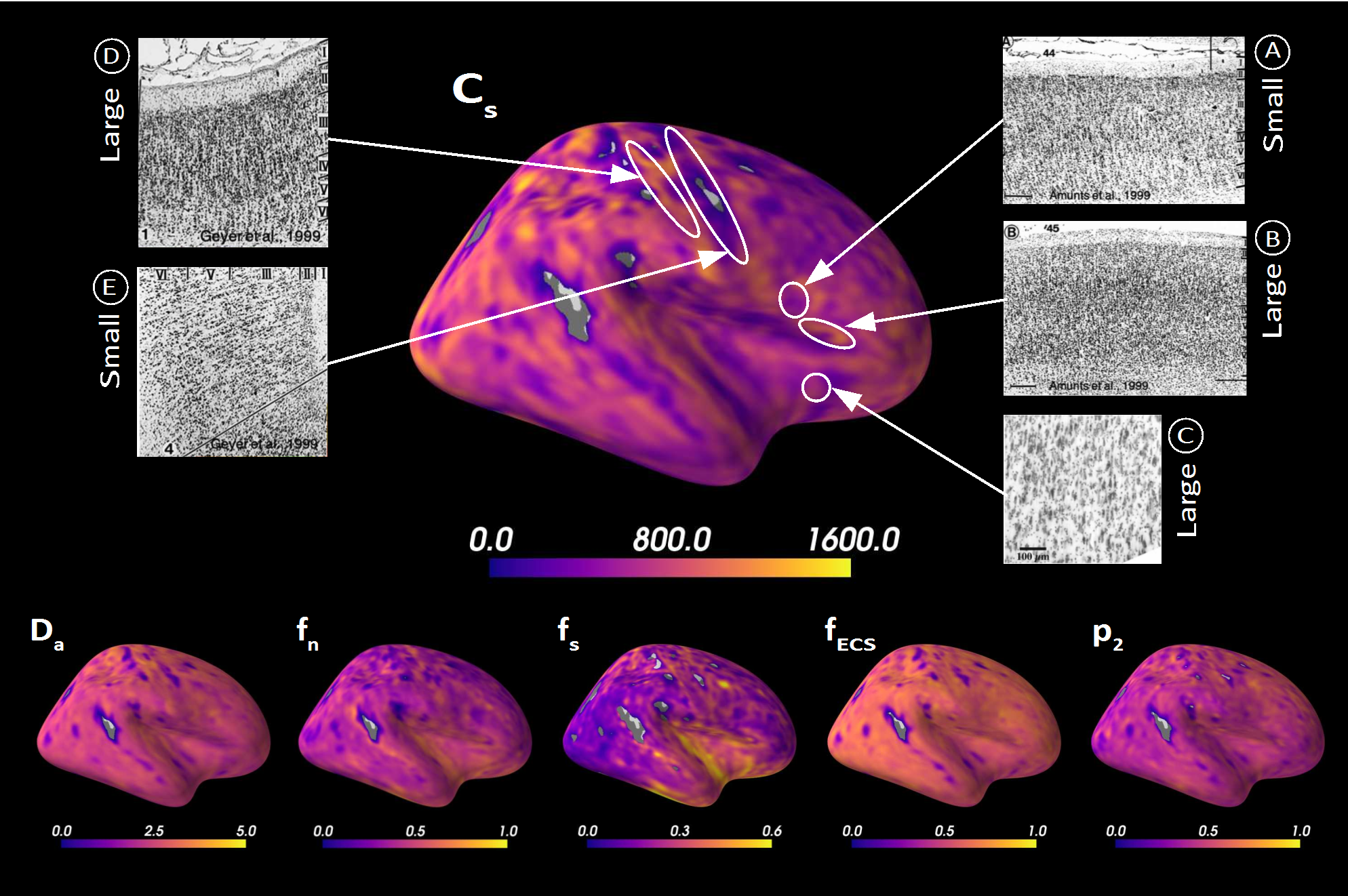 Jallais et al., MELBA (2021) Biophysical model parameters estimated using simulation-based inference averaged over 31 HCP MGH subjects.
I developed an innovative approach, dubbed µGUIDE, to tackle a critical challenge in neuroimaging: the lack of interpretable, reliable uncertainty estimates in imaging biomarkers. µGUIDE provides a flexible Bayesian approach that approximates posterior distributions in inverse problems such as diffusion MRI, bridging a long-standing gap between fast but limited point-estimate methods and computationally expensive Monte Carlo approaches. This work allows to quantify uncertainty across qMRI methods and lays a foundation for more trustworthy and reproducible clinical imaging. The code is openly available on GitHub.
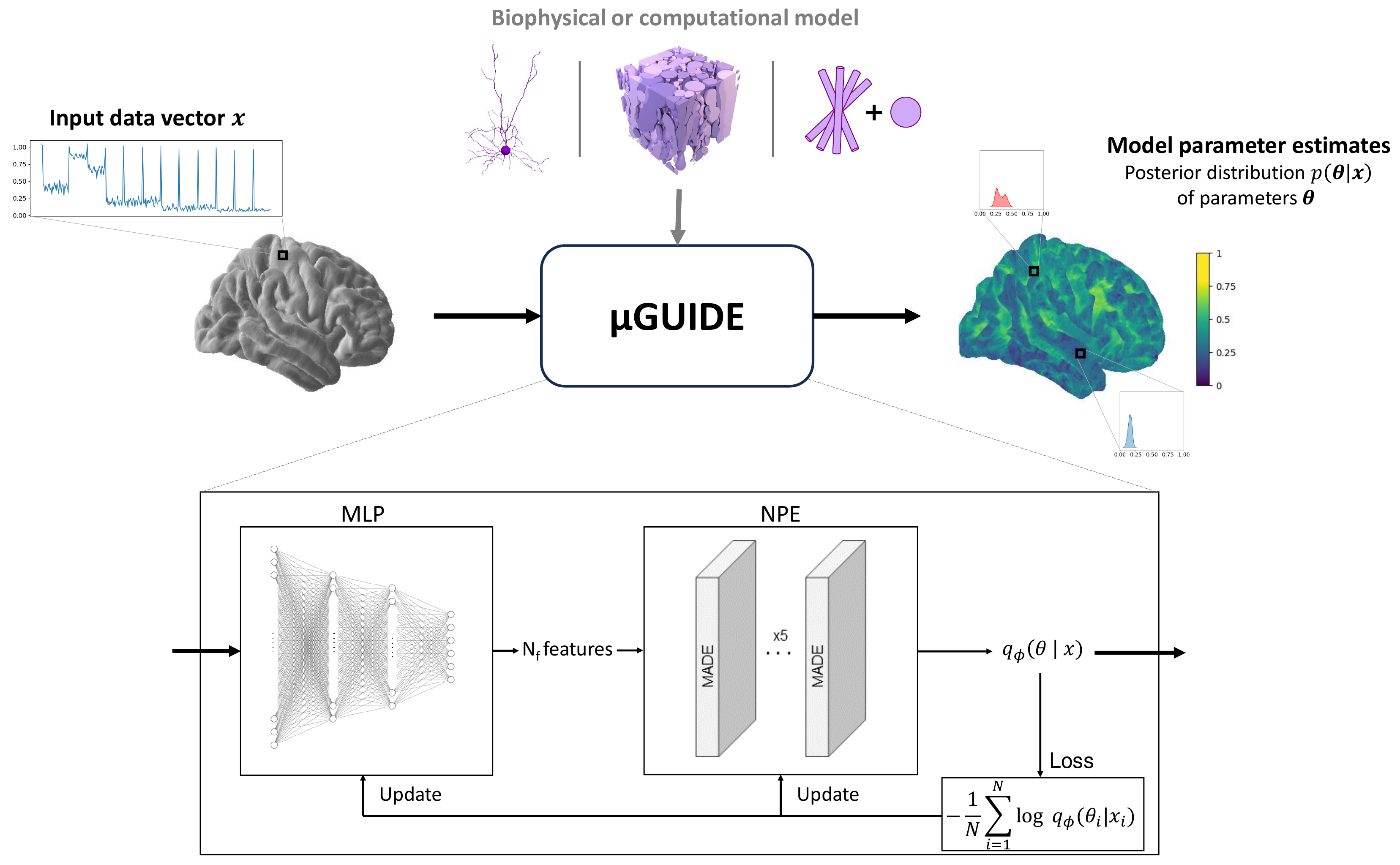 Jallais and Palombo, eLife (2024) µGUIDE framework: µGUIDE takes as input an observed data vector and relies on the definition of a biophysical or computational model. It outputs a posterior distribution of the biophysical model parameters. {:.figcaption}
I improved the reliability of biomarker estimates by proposing an efficient and scalable hierarchical Bayesian inference framework that leverages shared information across voxels to reduce voxel-wise uncertainty and degeneracy, while jointly learning a probabilistic brain parcellation.
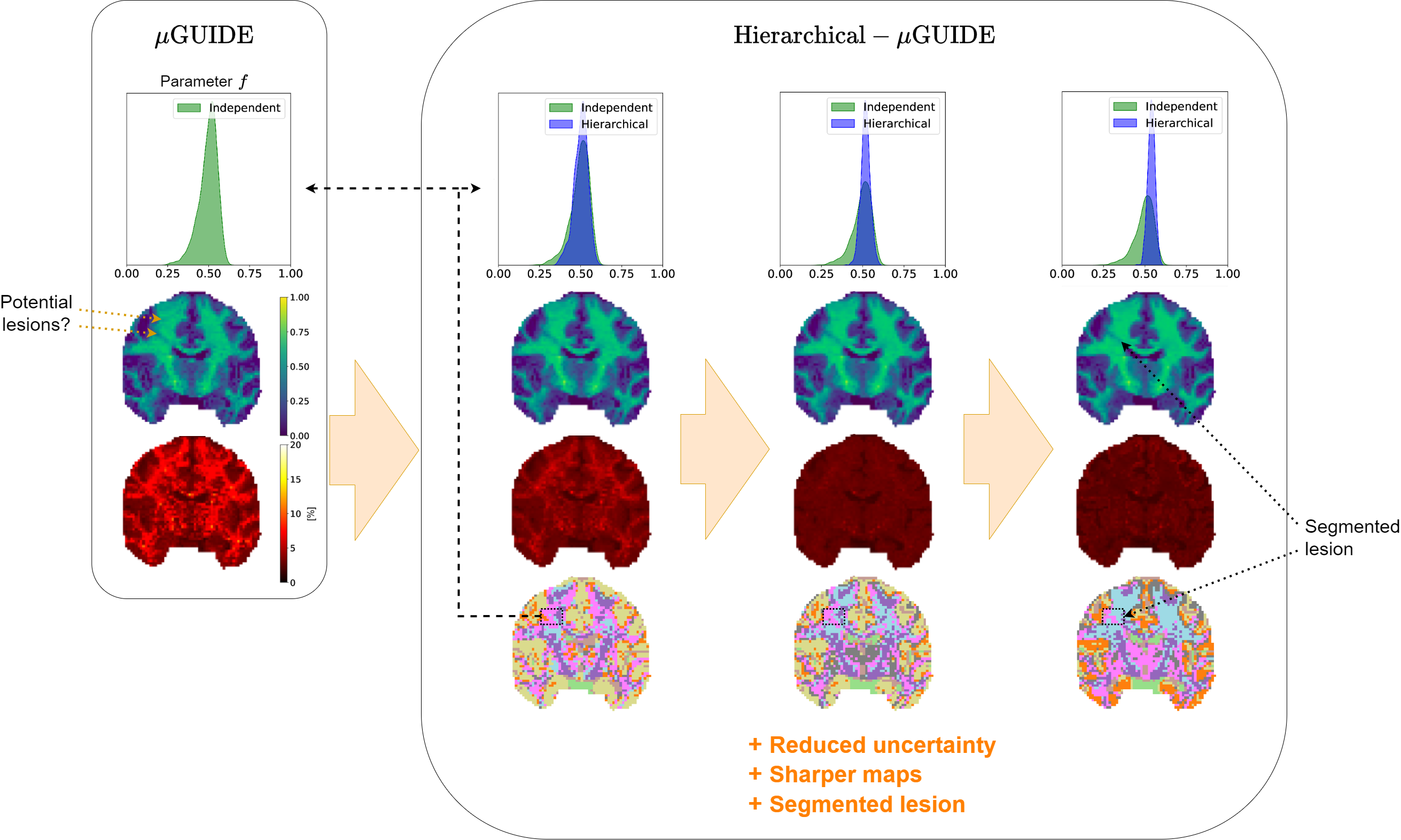 Rouillard, Wassermann, Palombo, Jallais. ISMRM (2024) Evolution of the mean, uncertainty (relative standard deviation), and parcellation of biophysical model parameters during training on a slice of a participant with epilepsy.
I evaluated the reliability of recent biophysical models of grey matter that incorporate water exchange (NEXI and SANDIX), using both simulations and in vivo data. Using uncertainty-aware inference (µGUIDE), we showed that several key parameters (e.g. exchange time, soma size) are difficult to estimate reliably under realistic conditions and are prone to bias. This study highlights fundamental limitations of current modelling approaches and demonstrates the importance of uncertainty and degeneracy quantification to ensure robust and interpretable results. It shows that uncertainty can be used to identify and filter unreliable estimates and guide experimental design.
 Jallais, Uhl, Pavan, Molendowska, Jones, Jelescu, Palombo. ArXiv (2026) Comparison of parameter estimates across cortical ribbons from participants scanned on the Connectom 1.0 using µGUIDE and a NLLS method. µGUIDE estimates are thresholded based on posterior distribution uncertainty, with distributions shown for voxels with uncertainty below 50%, 30%, and 10%. In some cases, thresholding does not alter the distribution, resulting in overlapping curves that may not be visually distinguishable.
We identified a critical flaw in current machine learning approaches for diffusion MRI, demonstrating that supervised ML models trained on simulated dMRI data can produce biased and misleading microstructure estimates due to mismatches between simulated and real noise distributions (covariate shift), and proposed a principled solution based on realistic noise synthesis.
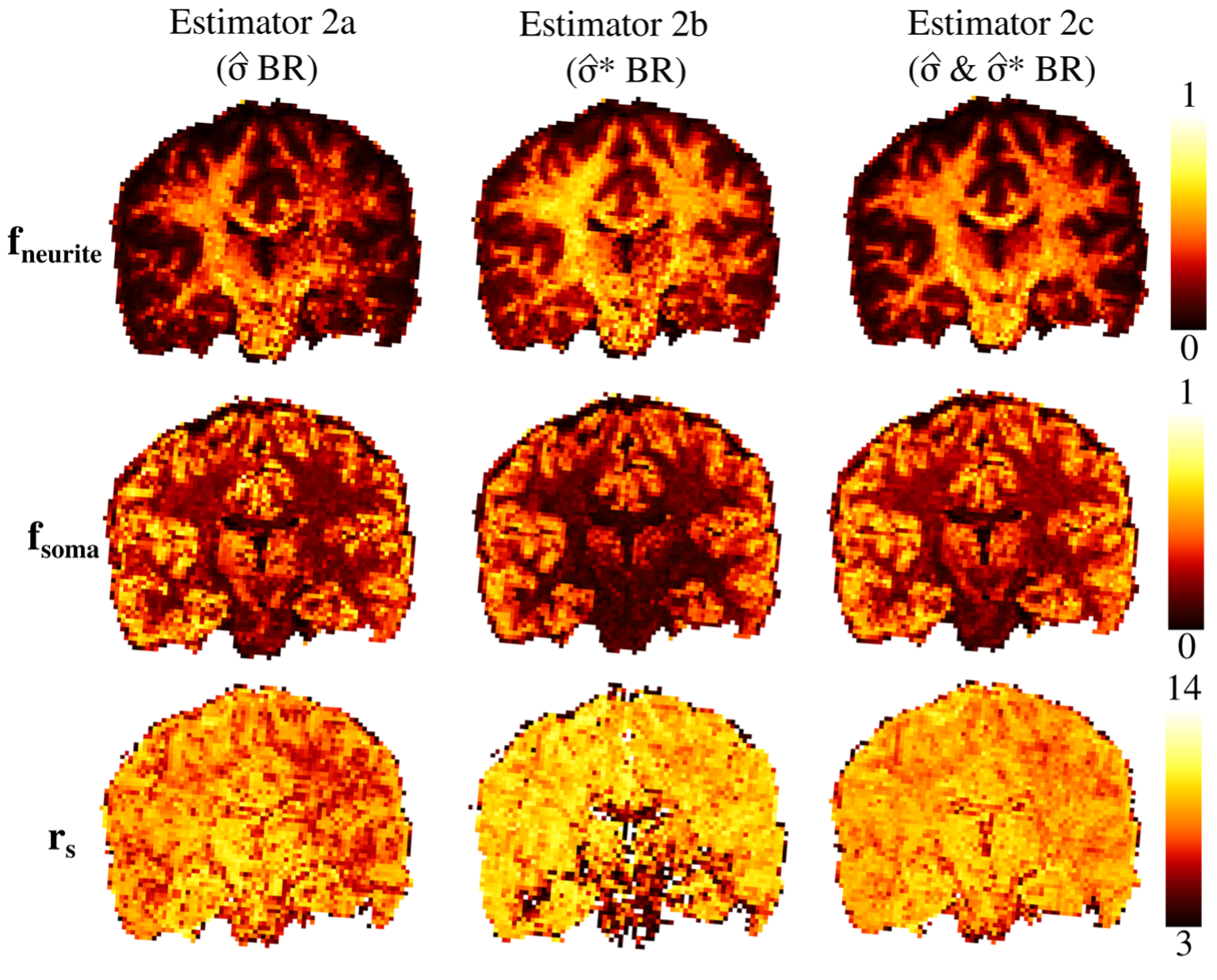 Karat*, Jallais*, Khan, Aja-Fernández, Veraart, Palombo. ArXiv (2026) SANDI-derived parameter maps from a single subject: intra-neurite signal fraction ($f_neurite$), soma signal fraction (f_soma), and soma radius r_s. Estimates are shown for a Bootstrap-aggregating Begressor (BR) trained on simulated signals with Rician offset (Estimator 2a), zero-mean Gaussian noise (Estimator 2b) and for the same regressor trained using the proposed Realistic Noise Synthesis (RNS) framework (Estimator 2c). Incorporating realistic noise during training improves anatomical contrast and reduces extreme parameter estimates, particularly for the soma radius.
I demonstrated that combining single and double diffusion encoding MR spectroscopy acquisitions enhances sensitivity to dendritic spine density, using advanced computational modelling of metabolite diffusion. This work demonstrates that integrating computational modelling with acquisition design can reveal measurable signatures of complex cellular features, providing a general framework for developing more informative neuroimaging protocols.
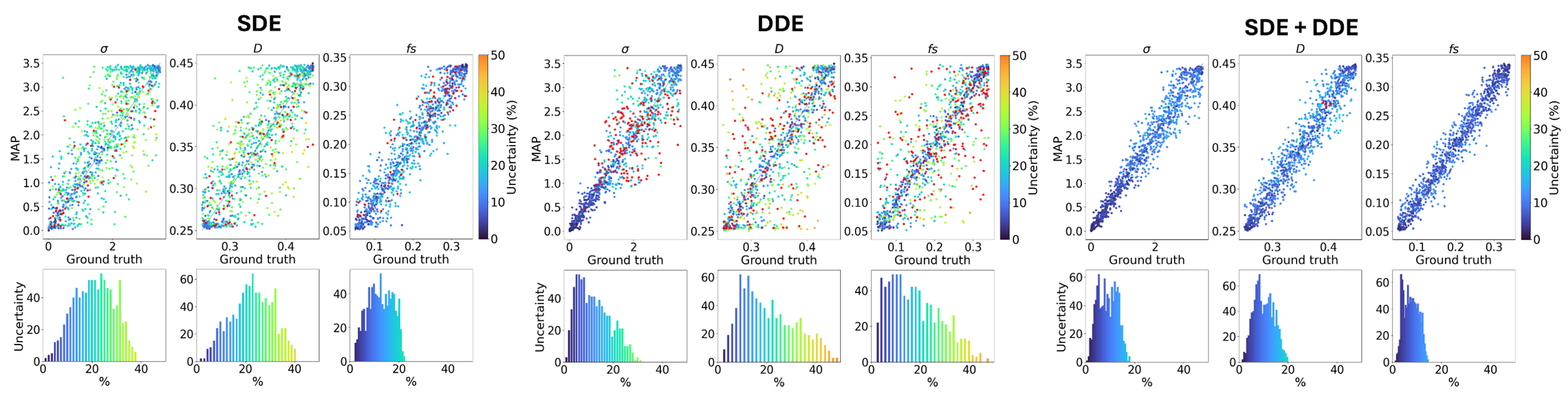 Jallais, Malaquin, Simsek, Valette, Palombo. ISMRM (2025) Estimated maximum-a-posteriori (MAPs) vs ground truth values of dendritic spine density, diffusivity and soma fraction used for generating the simulations, and the distribution of the uncertainty.
Invited Talks
Inauguration of the New 3T MRI Scanner at the Neuroinfo Platform in Rennes: Invited talk, June 2026.
Title: Exploring Brain Microstructure with High-Gradient Diffusion MRIBIC MR Education Series: Invited talk at the British & Irish Chapter of ISMRM, March 2026 (online).
Title: High Performance Neuro MRI: Insights into Grey Matter MicrostructureESMRMB 2025 Precongress Workshop on Microstructural Imaging Invited talk, European Society for Magnetic Resonance in Medicine and Biology, Oct 2025, Marseille (France).
Title: Emerging AI Methods for Microstructure Parameter Estimation in Diffusion MRIDIPY Workshop 2025 Keynote presentation, March 2025 (online).
Title: Fast and Robust Simulation-Based Bayesian Inference with AIMIML 2023 Invited talk, Microstructure Imaging Meets Machine Learning workshop, Sept 2023, Cardiff (UK).
Title: Fast and Robust Likelihood-Free Bayesian Inference with Machine Learning
Awards
ISMRM Junior Fellow (2025) This program has been established to recognize outstanding researchers and clinicians at an early stage in their careers, with an established and long-term commitment to ISMRM.
John Griffiths Award for Preclinical MR (2025) Second prize at the British and Irish Chapter of ISMRM.
Winner of the ISMRM Shark Tank Competition (2024) International entrepreneurial competition including mock interviews for convincing investors to invest in a hypothetical new company based on innovative ideas, with an expert judge panel.
ISMRM Magna Cum Laude Merit Award (2024) Trainee member award for an abstract ranked in the top 15\% within the Diffusion MRI category.
Mansfield Research Innovation Award (2024) Awarded £1500 from the British \& Irish Chapter of ISMRM and Siemens to attend the annual ISMRM conference in Singapore.
ISMRM Summa Cum Laude Merit Award (2023) Trainee member award for an abstract ranked in the top 5\% within the Diffusion MRI category.
ISMRM Magna Cum Laude Merit Award (2021) Trainee member award for an abstract ranked in the top 15\% within the Diffusion MRI category.
Grants
EBRAINS Roadmap 2026–2036 Contributor to the successful proposal “Equitable Brain Digital Twin Technology: point of care and worldwide adoption”, led by Prof. Wheeler-Kingshott.
UKRI STFC Africa–UK Physics Partnership (2025) Co-applicant on the project “Physics-Led Development of Brain Digital Twin Technology Using Low-Cost MRI and EEG in Sub-Saharan Africa” led by Prof. Wheeler-Kingshott, starting in April 2026 (2 years).
NMHII Future Leaders in Research Conference Funding (2026) Awarded £1000 for attending the annual ISMRM conference in Cape Town (South Africa).
Travel Award, Guarantors of Brain (2025) Awarded £1200 for attending the ISMRM Workshop on 40 Years of Diffusion: Past, Present \& Future Perspectives in Kyoto (Japan).
Taith Research Mobility Award (2025) Awarded £1800 for a research visit of a PhD student from the Technical University of Denmark (Thina Lundsgaard Thogersen, co-supervised by Marco Pizzolato and Tim Dyrby) for 3 weeks in CUBRIC.
SFRMBM & FLI Travel Grant (2024) Awarded 500€ for attending the annual scientific ESMRMB conference in Barcelona (Spain).
SFRMBM & FLI Travel Grant (2024) Awarded 500€ for attending the annual ISMRM conference in Singapore.
Guarantors of Brain Travel Award (2023) Awarded £1000 for attending the annual ISMRM conference in Toronto (Canada).
SFRMBM & FLI Travel Grant (2023) Awarded 500€ for attending the annual ISMRM conference in Toronto (Canada).
Reviewer
- Reviewer for research-focused journals:
- Advanced Science
- Medical Image Analysis
- Magnetic Resonance in Medicine
- Imaging Neuroscience
- Human Brain Mapping
- NeuroImage
- Reviewer for the ISMRM annual conference since 2023
- Reviewer for a final year master student in 2024 at Rennes University (France) on Anatomy- and microstructure-informed tractography for connectivity evaluation.
Other Experiences
Co-organizer of the ESMRMB precongress workshop on Microstructure Imaging in Girona, Spain (October 2026). Full day workshop providing an overview of state-of-the-art microstructure imaging with invited leading researchers within their respective fields.
Co-organizer of the Transferable Skills sessions at the ISMRM 2026 Annual Meeting in Cape Town, South Africa (May 2026). Designed and coordinated (4-person team) a six-session program delivering professional development and broader research skills beyond technical topics, featuring invited leading experts across academia and industry.
Co-organizer (with three junior fellows) of the From Method to Medicine: Bridging Impact Factor and Real-World Impact session at the ISMRM 2026 Annual Meeting in Cape Town, South Africa (May 2026). Lead the development and delivery of a focused session exploring the translation of methodological research into clinical and real-world impact, with invited expert speakers.
Chair and organizer of the MicroPhysics Meetings at CUBRIC (2024–present). Weekly meetings including a team of 40 people working on microstructure imaging at CUBRIC.
Organizer of the Visual Computing Hackathon at Cardiff University (June 2024). International three-day event bringing researchers together to collaborate on open science projects in neuroimaging and computer science.
Chair and organizer of the Skill Session Meetings at CUBRIC (2022–2023). Aims to give tutorial presentations once a week by invited speakers.
Planner and organizer of CUBRIC MicroTeam Retreat (May 2023).
Chair and organizer of CUBRIC Centre Conference (January 2023). One day conference involving 100 researchers.
Rendez-vous des Jeunes Mathématiciennes et Informaticiennes (2020 & 2021), organised by Inria Saclay and Animaths. Aims to encourage female high school students to pursue scientific studies.
Relief worker, teaching English to schoolchildren (June–July 2014). Bali.
Organizer at summer camps (2013 & 2014), Telligo, France.
President of a dance club, CPE Lyon (2012–2016), Lyon, France.
Trainer and judge in Rhythmic Gymnastic, RSGR (2009–2012), Rambouillet, France.